RAMAN GUPTA
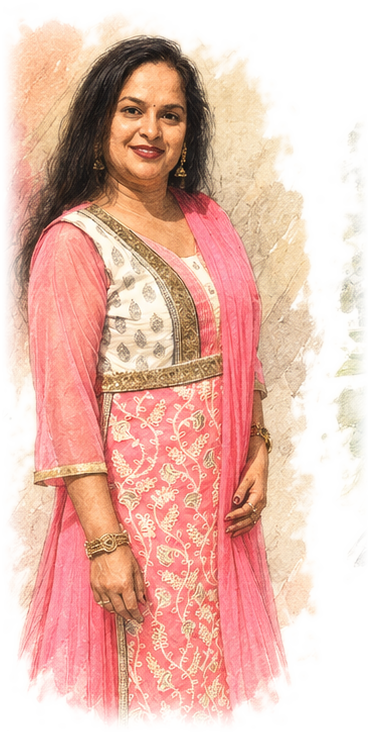
A pencil and watercolor portrait of Monika, whom Raman calls Rimpy
← Family

Monika (Rimpy)

She came from a world of boundaries, yet gave each of us the freedom to find our own way.

Part One: How We Began

A detour from Paris. A lifetime with her.

I thought I was changing my travel plans. My family had something rather more permanent in mind.

This is a story I have told a hundred times. Perhaps more.

In December 1996, I was twenty-nine, living in America and itching to travel the world. I was holidaying in Paris, photographing the Eiffel Tower from underneath, above, sideways and everywhere else, when I bought a calling card to telephone my parents.

Mom reminded me, with considerable persuasion, that I could find time for Paris but not for a visit home. I suspected she had more than a family visit in mind. Still, I called my travel agent in America and changed my ticket to take me through India.

I landed in Delhi early on December 3. It was dark and cold, and my parents had come to collect me for the drive to Karnal. Almost as soon as I entered the car, photographs of prospective brides appeared. I was tired, there was barely enough light, and how was I supposed to choose a girl from a photograph anyway?

I had barely arrived in India, and already I was being asked to choose a future.

By eight that morning, I was told a family was coming to see me. They arrived, interviewed me and left. The following day, we were going to visit them.

I asked my cousin Sukant, who was visiting from Austria, to accompany me. Along with my parents, Dimpy, Rajni and their five-year-old daughter Gudiya, we headed to Panchkula for the first of several prospective-bride meetings planned that day.

It was Rimpy’s house. A huge feast awaited us, with her whole family gathered around. Everyone was there except her.

Among the dishes was a green barfi. During a moment alone with my family, I proposed a discreet voting system: “When she comes in, keep eating the green barfi if you like her. That way, I’ll know.” Looking back, it was a rather absurd way to approach meeting the woman I might marry.

After about ninety minutes, Rimpy appeared. She looked very nervous, did not smile and kept her eyes on the floor. I attempted small talk in front of everyone while keeping an eye on the sweets. It was extremely awkward.

Nobody ate the green barfi.

I was puzzled, but something about her held my attention. I asked if we could speak privately, and we were shown into a nearby room.

My first question was whether she was being pressured into this because I lived in America. If so, she could tell me, and I would say no on her behalf. She said that was not the case.

Then I made my disclosures. I told her about someone I had known in Singapore and said I would answer any questions she had. I had debts in America. I had an ankle with no movement, although it did not show when I walked or ran. I also drank and ate non-vegetarian food, neither of which I intended to give up.

Before she said yes, I wanted her to know she could say no.

That was about the extent of our conversation. No lengthy questions, no detailed examination of our compatibility. I said yes within twenty minutes. She took another twenty to say yes to me. To this day, I remind her that she took twice as long.

We were engaged that same day. That was the end of the day’s prospective-bride itinerary.

As for the untouched green barfi, our parents had found each other through a matrimonial advertisement in The Tribune. The families had already met several times, and arrangements were well underway before I arrived.

Everyone knew more about my visit than I did.

My clever little signal had been entirely unnecessary.

On December 12, just over a week after landing in India, I married Monika, whom I call Rimpy. This December, we will have been married for thirty years.

I could not have known, in those twenty minutes, how much she would come to mean to me. But here we are, still married. And happily, I can say.

I went to Paris to see the world. A detour through India introduced me to the woman I would share my life with.
Part Two: Everything Between Then and Now

We married in a week. The rest took years.

An apartment made ready, plans rewritten, and a life neither of us could have pictured in those first twenty minutes.

Rimpy joined me in America three months after our wedding, once she had her passport. I had returned ahead of her to prepare the apartment. One of my first purchases was a heavy-duty shredder.

I put it to enthusiastic use, clearing out papers and traces of my bachelor years. The apartment had to be Rimpy-ready. Apparently, my approach to a fresh beginning involved reducing parts of the past to very small pieces.

Learning to share a life required more than a shredder.

I had remained in touch with Valerie, someone from my past, and that understandably caused Rimpy discomfort. Looking back, I should have been more considerate. Being honest about my history did not remove my responsibility to be thoughtful about our present.

Much of our life together settled into place naturally. With Rimpy’s arrival, my expenses increased. Fortunately, so did my income and savings. I sometimes think my fortunes began changing when she arrived.

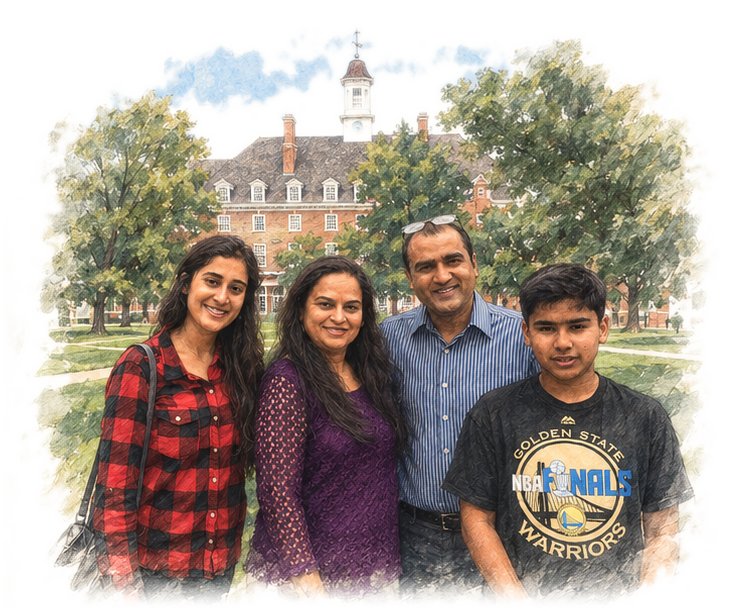
Plans to return to Singapore gave way to building a life in America. Green cards followed, and our family grew to include Raagini and Dev. What had been my apartment became our home.

For many years, Rimpy did not work outside the home, though it would be quite wrong to say she did not work. She was raising two children between the Indian world at home and the American world outside, while finding her own footing in a new country.

Both children still turn to her naturally. She is their mother, but also the person they want to tell things to.

The closeness they share today was built in all those ordinary days together.

About ten years ago, when the children were away studying and needed less day-to-day care, Rimpy trained to work with children with special needs at a local school. She continues that work today.

I can only imagine how demanding some days must be, physically and emotionally. Yet she brings patience, commitment and her own quiet élan to it. I am proud of the professional life she has built.

Rimpy has always been a wonderful cook. Although vegetarian herself, she learned to cook non-vegetarian dishes for the family and still does. Familiar acts of care are sometimes the ones we forget to acknowledge.

We have rarely had major disagreements. Cleanliness, however, remains a subject on which I bring considerable enthusiasm and very specific expectations. Rimpy has had nearly thirty years to become familiar with this quality. Whether she considers it a quality is another matter.

Through my ventures, changing interests and travel plans, she was a steady source of support. We travelled together, raised our children and gradually built a more secure life.

Her cancer diagnosis shook that life.

It frightened me and our family. I watched her face that period with courage and dignity, knowing that what I could see from beside her was not the whole of what she was experiencing. Today, I am grateful to see her looking after her health with renewed attention. The fuller story of those years is hers to tell.

There have been lighter changes too. For years, Rimpy drove us home from parties when I had enjoyed more drinks than I should have. She worried about my drinking, with reason.

A couple of years ago, I stopped drinking and eating non-vegetarian food. These days, she sometimes enjoys a glass of wine or a drink, and I drive her home.

After years of her driving me home, it is my turn. I rather enjoy the arrangement.

We have travelled widely, raised two children and made a home in America. Raagini and Dev remain close to us while building lives of their own. I look back with pride and forward with pleasure: more places to visit, ordinary evenings to enjoy, and more years together.

We began with a hurried wedding and an apartment I was determined to tidy.

Nearly thirty years later, I am still particular about cleanliness in the house. I am more grateful than ever for the woman who made it a home.

Part Three: She Made Room

She did not need us to live as she had.

Her clothes and confidence changed. Her openness was there all along.

Of all the people I have known, professionally and personally, growing up in India and through more than thirty years in America, Rimpy is one of the most progressive women I have ever met.

I do not say that because she is my wife. I say it because of the person I have watched her be.

She grew up in a household where her father’s decisions carried considerable authority and expectations about marriage and family were firmly established. From that world, she stepped into a life with me in Silicon Valley.

The contrast must have been enormous. She was not yet comfortable speaking or writing fluent English. Even wearing jeans was unfamiliar. Around her were women entirely at ease in Western clothes, some smoking, drinking and speaking with a freedom very different from what she had known.

Put us all in one room, and a Bollywood director would hardly have needed to explain the setup.

I do not think America made Rimpy progressive. My sense is that the openness was already hers. Here, she found more room to express it.

She found her place without becoming a copy of anyone else. Over time, she became someone many of our friends turned to, a reassuring presence and a host who could make everyone feel at home.

Cooking for twenty or thirty people seems to require remarkably little drama from her, though I know the apparent ease comes with considerable work. Her hospitality also extends well beyond a meal.

Distant relatives and people we were meeting for the first time have stayed with us for months. Some stays were easier than others. Yet she worked to make everyone feel welcome, not as though they were being counted down towards their departure.

She made room at the table, and then made room in our lives.

That openness matters even more in the way she relates to our children. She welcomes their partners and friends without making caste or religion a condition of belonging. She does not insist that they observe every ritual or inherit relationships simply because tradition says they should.

She can value her own upbringing without requiring the children to repeat it.

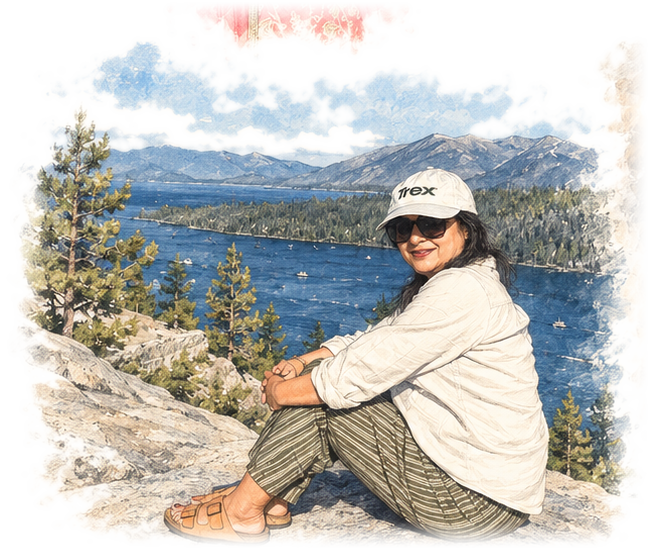
With me, that generosity is especially visible in travel. We have travelled together, but I also love travelling alone. Friends often ask, “How does she let you go on your own?”

I understand what they mean. But the question reminds me how fortunate I am. I have not merely been able to pursue something I love. I have had her support in doing it.

She has helped me live a life of my choosing, while sharing a life with me.

When my parents, my brother or another relative has needed financial help, Rimpy has often been the first to ask what we could do. The concern has come from her, not simply in response to a request from me.

None of this means she never worries, feels possessive or wants reassurance. There have been friendships and situations in which my behaviour gave her reason to feel uncomfortable. Looking back, I should sometimes have been more considerate.

Her trust did not relieve me of responsibility. It asked something of me too.

We have talked, disagreed and learned. I cannot praise the freedom she gave me without acknowledging that I needed to take better care of her feelings.

She is not indifferent. She loves closely, feels strongly and still makes room for choices that are not always her own.

When I call Rimpy progressive, I am talking about whom she welcomes, the choices she respects, and her willingness to question expectations she was raised with.

Rimpy is one of the most progressive women I have ever known. Being her husband is not my reason for saying it. It is how I came to know it.

Part Four: Between Her and Me

A few things between us. And a few I owe her.

Nearly thirty years together, and there are still things to say. Apparently, there is also a plant waiting to be potted.

Rimpy, after everything I have written about you, it seems only fair to leave room for a few things you might say about me.

Let us begin with the house.

Keeping it clean and orderly remains one of my particular concerns. You believe you have come a long way. I agree. You might wish I would end the sentence there.

Our expectations are still not identical, but we have moved closer. More importantly, we have found some peace with the difference. These days, I can get on with the cleaning or rearranging I feel compelled to do, and you let me do it without taking it personally. I appreciate that more than I probably say.

Now, about that plant.

You ask me to put a plant in a pot, and somehow the task can remain pending for days. When I decide something needs doing, I can accomplish quite a lot. When you decide, apparently I need time to consider the matter.

Worse, I can find time to do the same thing for a friend, even while insisting that I am busy.

I like things done promptly. You would be justified in asking why that does not always include the things you ask of me.

There is no particularly good defence. Your requests should not receive less attention simply because I am confident you will still be there tomorrow. That is something I need to get better at, preferably before writing another paragraph about how much I appreciate you.

We have had our share of arguments. Some had clear reasons. With others, I suspect neither of us could have explained, afterwards, quite how we got there.

These days, the arguments are quieter. But so, sometimes, are the ordinary conversations.

That change is more in me. It is not that I do not want to share things with you. I have become quieter, more inclined to stay inside my own thoughts. I do not entirely understand the change, but I notice it.

And I do not want fewer disagreements to become an excuse for fewer conversations.

There are things I still want to tell you. I need to get better at saying them aloud.

I would like us to walk together more often. Nothing elaborate. Just time outside, side by side, talking about whatever comes up. We have spent so many years discussing what needs doing. I would like more conversations that do not need to get anything done.

There is, however, one small creature that can complicate an otherwise perfectly good walk.

If I could wish away one fear for you, it would be your fear of lizards. I know it is real, even when I do not fully understand its intensity. I wish they occupied less space in your mind than they occasionally do in the backyard and around the house.

Not for my convenience. For the ease it might give you.

I cannot ask you simply to stop being afraid. But if you ever want to work on that fear, I would like to help in whatever way actually helps you.

When I think about the years ahead, I find myself imagining a different pace. Hopefully, retirement in a few years. An Airbnb somewhere we would like to spend time, not for a rushed weekend, but for a month or two. Long enough to have ordinary days in another place.

Walks, conversations, meals, and mornings without an urgent need to be somewhere else.

I have loved travelling the world. Now I also find myself looking forward to staying somewhere with you.

We will probably still disagree about where things belong. I may still need reminding about a plant. Retirement, I suspect, will not automatically make me a more prompt husband.

But I hope to become a more present one.

I want more time with you. And I do not want to wait until retirement to begin.