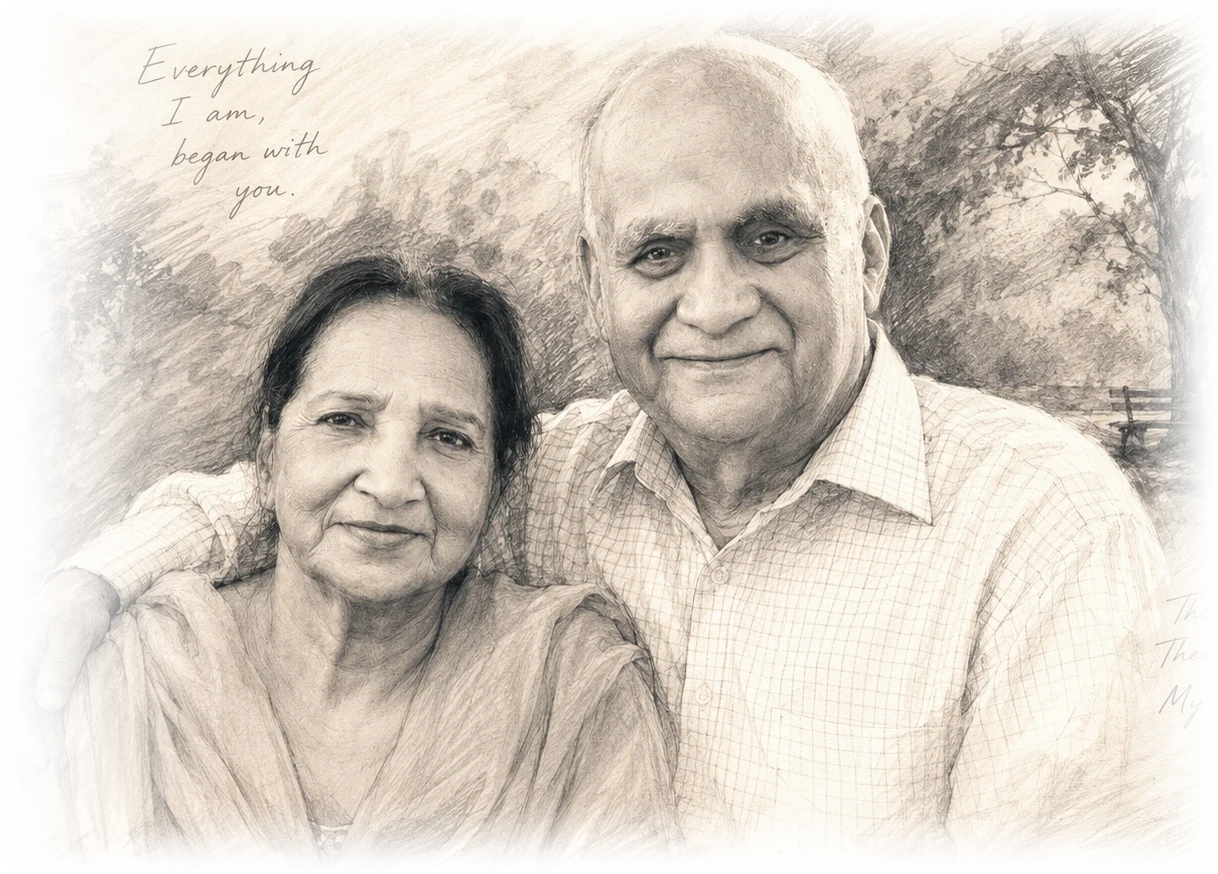
Part One: Their Story
Before they were Mom & Dad.
They found each other through a newspaper matrimonial advertisement, in a wonderfully unromantic piece of family history.
My parents came from families with very little.
My mother grew up in a small town in Punjab, one of six children: five sisters and a brother. They were lower middle class, but my maternal grandparents were remarkably progressive about one thing that mattered enormously: every child would be educated. Sons and daughters alike were expected to study and build a life for themselves.
My father came from a very different world. He was one of ten children, seven brothers and three sisters, from a remote village in Haryana. Education was not something his circumstances naturally provided. He had to pursue it largely through his own determination.
Somehow, both of them graduated. And then, in a wonderfully unromantic piece of family history, they found each other through a newspaper matrimonial advertisement. They married in 1966.
Both were teachers. Their combined income in those early years was tiny, roughly the equivalent of ten U.S. dollars a month, and soon there were two children to raise. So they saved. They saved almost everything they could. They lived simply, counted money carefully and postponed things that could be postponed. When I was five, they built their first home. For much of my childhood, that is how I understood them: two people working relentlessly to move a family forward.
Looking back as an adult, I notice things I did not fully appreciate as a child. Both my parents taught, but much of the work at home also fell to Mom. Dad took the lead in most household decisions and managed the family’s finances, including both their earnings.
Mom often balanced the needs of her children with the expectations of the household. I saw what she did for us, but rarely thought to ask what she wanted for herself. Today, I appreciate how much she carried, while recognising that her experience is hers to describe, not mine to assume.
Alongside their commitment to the family, there were tensions I remember clearly. Relations with each other's extended families were sometimes difficult, and family gatherings could be followed by arguments at home.
I knew their marriage as their child, not from inside it. I saw tensions, commitment and a lifetime of shared responsibilities. There were parts of their relationship I could never fully know.
They shared two children, a home they had built from almost nothing and more than fifty years of history. Perhaps there were forms of affection I did not recognize because I was looking for them in a different language.
What I do know is what their life produced. Two teachers with very little money raised two children, educated them and gave them opportunities far beyond those with which either parent had begun. Eventually, one of those children left India and was able to help make the family's financial life easier.
When the time came that I could afford to do it, I asked both of them to retire. My father retired first, only a few days before my mother. It was a small reversal that has stayed with me. For decades they had worked so that their children might have choices. Eventually, one of those children could give them the choice to stop working.
My father died in 2018, fifty-two years after they married.
I am still learning to see them as people, not only as my parents.
After Dad died, I noticed Mom making more everyday choices for herself. I cannot speak for everything she felt, but I was glad to see her have that space.
Alongside what I wish had been different, I remain grateful for how hard my father worked, what he overcame and the opportunities his determination helped create for us.
I can be grateful to my father and still see his faults. I can admire my mother's strength while also wondering how much of herself she had to put aside. And perhaps that is one of the things age changes about the way we see our parents.
As children, we know them simply as Mom and Dad.
Much later, if we are willing to look closely enough, we begin to see the two complicated human beings who were there all along.