RAMAN GUPTA

My People

Somewhere between where we come from and where life takes us, we find our people.

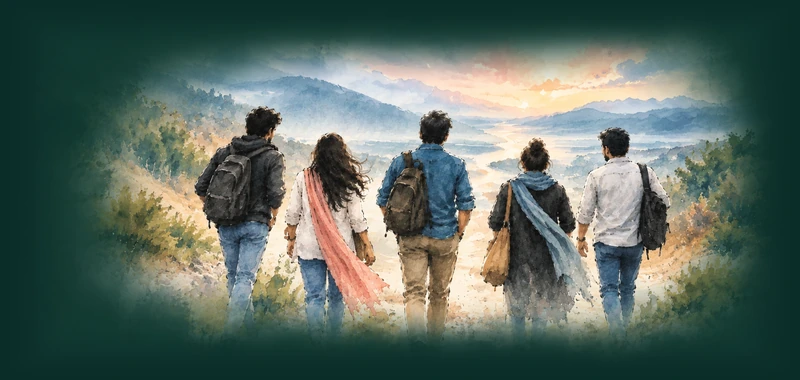
Watercolor sketch of friends walking together toward the horizon

01 · Friend

Meenu

Two postal addresses. Everything else followed.

Watercolor portrait of Meenu

I met Meenu in college, although “met” may be giving our early relationship more credit than it deserves. I had arrived straight from military school, an all-boys school, and had spent years surrounded by boys with almost no idea how to talk to girls. My solution was simple: don't.

I stayed safely within the company of my old military-school friends. Meenu, meanwhile, was apparently someone everyone knew. She had an aura around her and was very much the go-to girl in the class. I was quite oblivious to all of it. We hardly spoke. In fact, when Meenu ran for the college student-body elections, I encouraged one of my old schoolmates to contest against her.

An excellent foundation for a lifelong friendship.

And then, just when we were about to go our separate ways, something changed. I left to join BIT Mesra. Meenu stayed behind at the university where we had met. By every reasonable calculation, whatever little acquaintance we had should have ended there. Instead, sometime during those last few days, we exchanged addresses. Real addresses.

This was the age of handwritten letters, envelopes, stamps and postmen. I would write to Meenu, drop the letter into the mail and wait for hers to arrive. The wait could be agonizing. There was no email, no WhatsApp, no blue tick telling you somebody had read what you had written. You simply waited for the postman. Then her letter would arrive. I would read it, write another one, drop it into the mail, and the cycle would begin again.

Somehow, two people who had barely spoken while sitting in the same college became close friends after moving hundreds of miles apart.

And Then Life Happened

I graduated. Meenu found Arun, one of the nicest people I know and perhaps the only man in the world adequately equipped to handle Meenu the firebrand. Although “firebrand” only describes part of her. I have always thought of Meenu a little like an ocean. The surface can look remarkably calm. There is usually considerably more happening underneath.

For a while we were both working in Delhi, both starting our adult lives from fairly humble beginnings. Meenu was working at a trading house. She married Arun. I moved to Singapore. Meenu and Arun started a business of their own. I moved to America, came back to India a year later and married Rimpy.

Careers happened. Marriages happened. Children happened. Countries changed. The friendship stayed. And so did the fighting.

Meenu and I can argue about almost anything. Travel simply gives us more opportunities. I am a stickler for time. If we are supposed to leave at 8:00, I will probably be ready at 7:55 wondering why everyone else isn't. Meenu belongs to a different school of timekeeping: the late-lateef school. For her, 8:00 is perhaps less a time than an opening suggestion. This has led to many discussions, some conducted at a volume that a discussion about a clock probably did not require.

And yet, we travel again. Perhaps that says more about our friendship than anything else I could write.

Different Rules Apply

Once, when Meenu was visiting us in America, we were driving from San Francisco to Los Angeles. Along the way were acres and acres of fruit trees, and Meenu decided she wanted to pluck a fruit. I explained that this was America. You couldn't simply stop beside somebody's farm and start helping yourself to their fruit. This did not concern her sufficiently, so I escalated. I told her it was practically a felony, a very serious offense, possibly one of the highest forms of crime committed on American soil.

Meenu remained unmoved. She wanted the fruit. I stopped the car.

Years later, Rimpy and I were driving somewhere when she spotted some pomegranates and asked me to stop so she could pick one. I said no.

Rimpy looked at me. “If it were Meenu, would you stop?” I didn't need much time to think. “Yes.”

Rimpy knew the answer before she asked. I am not entirely sure what that says about me as a husband. But it probably tells you everything you need to know about my friendship with Meenu.

Proud

Meenu and Arun started with fairly humble beginnings. Over the years, I watched them build something extraordinary together, and I am enormously proud of them. Success can occasionally do strange things between friends. Comparison creeps in. Someone else's achievement can sometimes make you look at your own life differently.

I have never felt that with Meenu. Her success has always made me happy. Her victories have always made me proud.

These days, if I tell her to slow down, it isn't because I want her to achieve less. She has already proved whatever needed proving. Now I want her to take care of herself and have enough time, and good enough health, to enjoy everything she and Arun worked so hard to build. I am reasonably certain she will ignore this advice too.

A Phone Call Away

Meenu has visited us in America many times over the years. And whenever I go to India, there is a ritual: I visit Meenu and Arun. It doesn't particularly matter how short the India trip is. Somehow, that visit has to happen. Maybe we eat. We talk. We remember things. Almost certainly Meenu and I will find something to argue about.

There is also, I think, an element of taking each other for granted in our friendship. I don't necessarily mean that as a bad thing. There is a certain luxury in taking someone for granted when what you are really taking for granted is that they will be there. We don't count who called whom last. We don't need to constantly reassure each other that the friendship still exists. Sometimes too much time passes. But beneath all of that is an assumption I have carried for decades.

If I ever really need Meenu, she is a phone call away. And I hope she knows the same is true in the other direction.

When I look back now, the whole friendship seems wonderfully improbable. The girl I barely spoke to. The election candidate I tried to get someone to defeat. The letters and the postman. BIT Mesra, Delhi, Singapore and America. Marriages, children, successes, arguments. And several decades without Meenu learning to be on time.

Strange, when you think about it. We spent years in the same college and barely became friends. Then, just when life was taking us in different directions, we exchanged two postal addresses. Everything else followed.

Back to My People ↑

02 · Friend

Asmat

A friend I have never met.

Watercolor portrait of Asmat

I grew up listening to Mirza Ghalib. There was that magnificent television series with Naseeruddin Shah as Ghalib, Gulzar directing, and Jagjit Singh singing the ghazals. What a trio. It all sounded extraordinarily intellectual, sophisticated, layered and profound.

There was only one small problem. I didn't understand half of what Ghalib was saying. That, of course, did not prevent me from saying wah wah at all the appropriate moments.

Years later, I decided perhaps it was time to actually understand the man I had been admiring for so long. And if I wanted to understand Ghalib, why not start at the beginning? Learn Urdu.

So I went online looking for an Urdu teacher. I scrolled left, scrolled right, and after a while every profile began looking remarkably similar. Eventually I chose a young woman from Pakistan. Her name was Asmat.

Eight dollars an hour. Twice a week, usually over the weekend. The Urdu lessons began. So did a friendship.

My Pakistani Ustaad

Asmat, I should say, was a hard teacher hiding behind an amazingly beautiful face. Always in her hijab, always ready to correct me. Every time I made a mistake, I could almost feel a Pakistani ruler landing on an Indian knuckle. Perhaps there is a metaphor for our two countries somewhere in there.

Between Urdu words, pronunciation and whatever homework I had failed to do properly, we started talking. Small conversations at first, then about our lives, our countries, politics and religion. Two people sitting on opposite sides of one of the most complicated borders in the world discovered that we agreed on a surprising amount, particularly about the absurdity of politics dividing people and religion being used to polarize them.

Eventually the Urdu lessons stopped. The WhatsApp messages didn't.

Across a Border

I would send Asmat photographs and stories from my travels. She would tell me about her plans and dreams, including her ambition to make millions. She will almost certainly deny this. I am putting it in writing anyway.

Over time, something very simple developed between us. She wishes me on Diwali. I wish her on Eid. I respect her faith and her country. She respects mine. Neither of us has ever needed the other to become a little less Pakistani or a little less Indian for the friendship to work.

I think that matters.

There is a certain freedom in our friendship. We can say almost anything to each other and simply be ourselves. Maybe that freedom comes from knowing where the boundaries are without ever needing to draw them. With Asmat, some things simply don't need explaining.

A Friend I Have Never Met

Here is the strange part. I have never met Asmat. Not once.

Outside our Urdu classes, I don't think we have even spoken very many times. And yet I call her my friend without hesitation.

It makes me wonder what actually qualifies someone for that word. Is it how many dinners you have shared? How many photographs you have together? How often you meet?

Or can friendship sometimes be something quieter? Knowing something about another person's hopes. Respecting what matters to them. Remembering their festivals. Teasing them about becoming a millionaire. Simply being glad that somewhere on the other side of a border they exist.

Asmat is getting married soon.

I would genuinely love to attend her nikah. I don't know whether I will be able to.

I have told her that one day I would like to visit Pakistan. Not as country number whatever. Not to put another pin on a map.

To meet my friend.

Maybe that day will come. Maybe it won't.

One Day

I hope Allah gives Asmat everything she wishes for herself. Happiness in her marriage. Success. Peace.

And yes, the millions too.

But I have one small wish of my own.

That someday the border between the countries we happened to be born in becomes less important than the friendship we happened to find.

That a girl from Pakistan and a boy from India who met because of a nineteenth-century poet can finally cross that border and give each other a hug.

Until then, perhaps Ghalib gets the last word.

हज़ारों ख़्वाहिशें ऐसी कि हर ख़्वाहिश पे दम निकले...
Hazaaron khwahishein aisi ki har khwahish pe dam nikle...

Thousands of desires, each one powerful enough to take your breath away.

I had gone looking for someone to teach me how to understand Ghalib.

I found Asmat instead. And perhaps, somewhere along the way, understood a little more than Urdu.

Back to My People ↑